
Powering White County's Future
A closed-loop, minimal-water data campus that pays for its own infrastructure, seeks no incentives, and lowers property taxes for every taxpayer in the county.
Built to be a good neighbor from day one.
Planned investment
Billions of dollars in private capital and approximately 1,000 construction jobs over the build-out.
Tax cut for all
The project triggers property-tax cuts for everyone in White County once the campus reaches full build-out.
Responsible
Pays for all its own infrastructure and is not seeking incentives, abatements, or subsidies.
Sustainable & quiet
Closed-loop, dry-cooled, using minimal water for operations — and about as quiet as a standard office building.
Project Overview
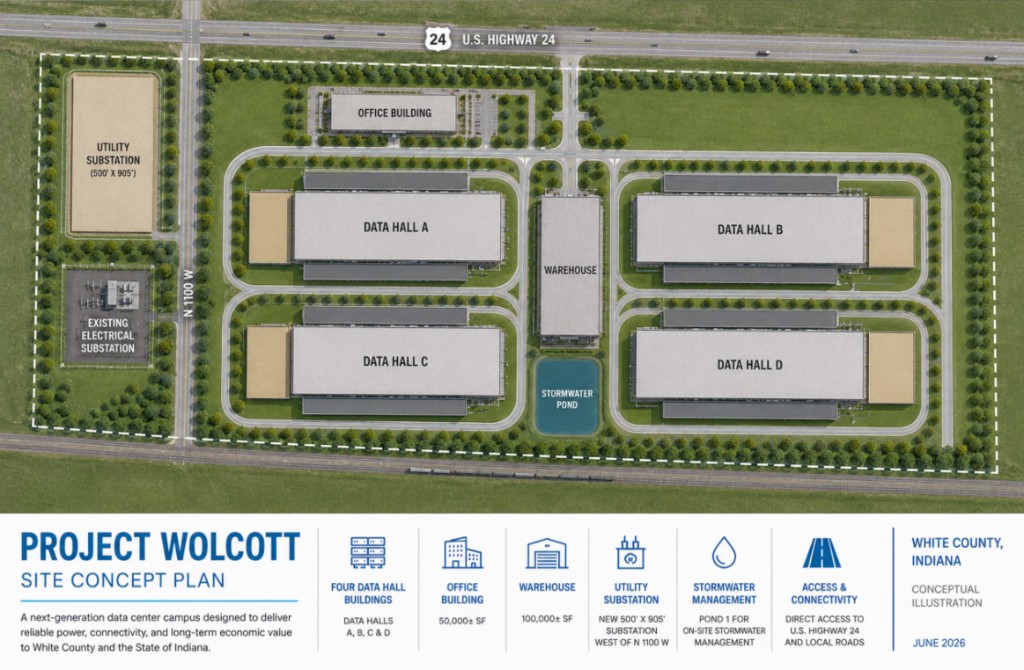
Site concept plan — four data halls, support office, warehouse, stormwater pond, and utility substation along U.S. Highway 24. Illustrative; subject to final engineering.
- Campus Size
- 322 Acres
- Site Plan
- 4 data center buildings
- Building Footprint
- 327,612 Square Feet each
- Data building height
- Under 30'
- Office
- 50,000 Square Feet
- Warehouse
- 100,000 Square Feet
- Setbacks
- Significant setbacks, the shortest from US-24 will be over 700 feet
- Noise Limit
- Less than 50 dB-A at any affected adjacent dwelling, this will be quieter than traffic noise on US-24
- Water
- Closed-loop cooling to limit water usage to employees only, much like a regular office building
What this means for White County.
A long-term commitment
Substantial real estate taxes paid into the county for the life of the campus — a durable new source of public revenue.
Jobs for the county
Approximately 1,000 construction jobs during build-out, plus full-time operating roles once the campus is live.
A responsible neighbor
- No incentives, abatements, or subsidies sought
- Closed-loop cooling system
- The project will pay for its own electric
- No wells on the property
Savings for property owners
The scale of this project spreads the county's tax base wider, so other property owners pay less.
Separating myth from fact.
Big projects can attract big speculation. Here are the most common concerns, answered with what our specific plan says.
“This data center will drain our water.”
The campus runs on a closed-loop system that consumes zero water for cooling and minimal water for operations. The only significant water use serves employee needs. There are no wells on the property and no draw on agricultural or residential supply.
“It'll raise my electric bill.”
The project pays for all of its own electric infrastructure and is not seeking incentives. Residential rates are set independently by local providers and are not subsidized by ratepayers for this campus.
“My property taxes will go up.”
The opposite. At full build-out in 2029 the project's assessed value spreads the tax base across the county, lowering rates for existing taxpayers. Tri-County School District residents see the largest reductions.
“You can hear the hum for miles.”
Noise is limited to under 50 dB-A at any affected adjacent dwelling — about the level of an office building, and quieter than traffic on US-24. Setbacks run as far as 797 ft from US-24.
“They're only here for a tax break.”
No incentives, abatements, or subsidies are being sought. The project funds its own infrastructure and contributes substantial real estate taxes to the county.
Designed around the land it sits on.
Water-efficient cooling
A closed-loop, dry-cooled system uses minimal water for operations, protecting residential and agricultural supply.
Stormwater management
An on-site stormwater pond and engineered drainage manage runoff and protect local waterways.
Significant setbacks
Significant buffers — the shortest setback from US-24 is 797 ft — soften the campus against neighboring land.
Regulatory compliance
Development and operations meet or exceed applicable federal, state, and local environmental standards.
More than a data campus.
Direct, tangible commitments to White County.
$35M in community enhancement
Direct investment in White County's long-term growth to support infrastructure, schools, and community programs.
Hundreds of full-time jobs
Prioritizing local hiring and supporting job training and growth.
Tens of millions paid in property tax annually
Significant, sustained growth in county revenue.
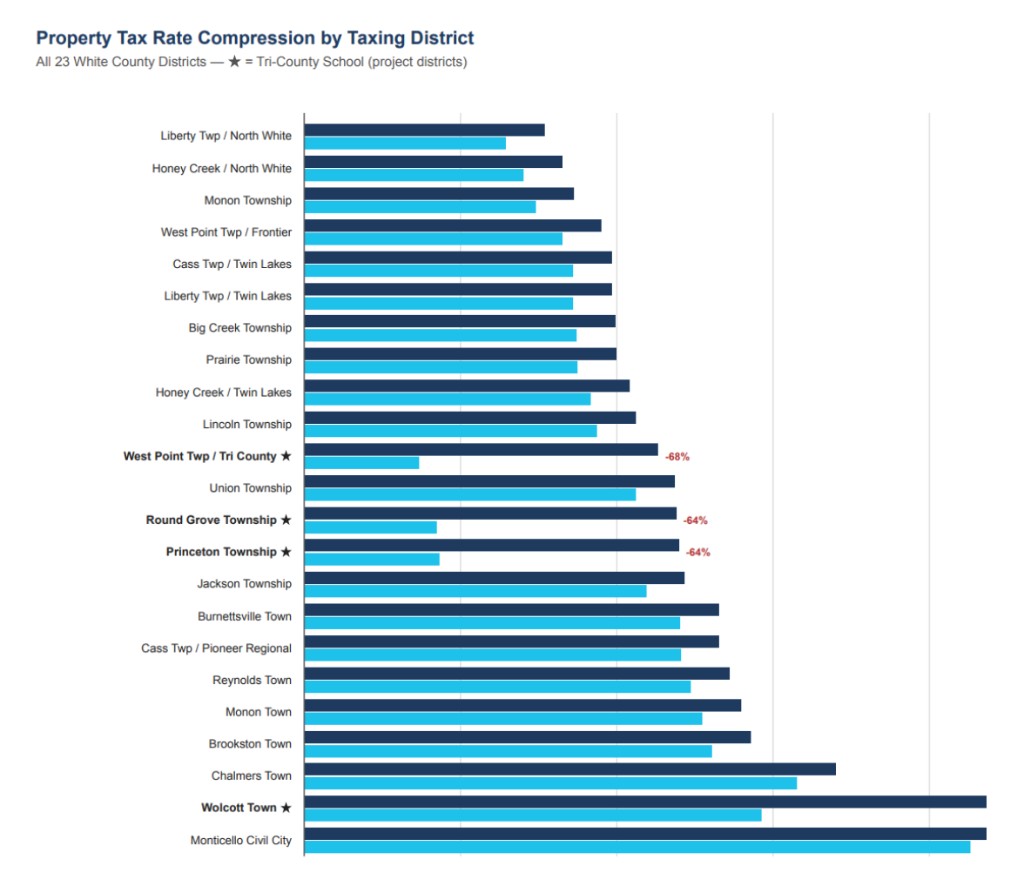
Every district pays less at full build-out.
The economic impact of this project means all White County property taxpayers will see significant savings on their own property taxes when the data center reaches full build-out in 2029. Residents in the Tri-County School District see the largest savings. Find your district in the chart below.
FAQ
Contact Us
Questions about the project, leasing, community partnerships, or want to share feedback? Send a note and the team will follow up.